eCommerce
Headless Commerce Explained: Is It Worth the Cost for Small and Mid-Size Stores?
Official technical references checked 16 October 2026. Costs are transparent planning assumptions; no performance or conversion uplift is claimed without measurement.
The quick answer: buy headless only when the separation solves a valuable problem
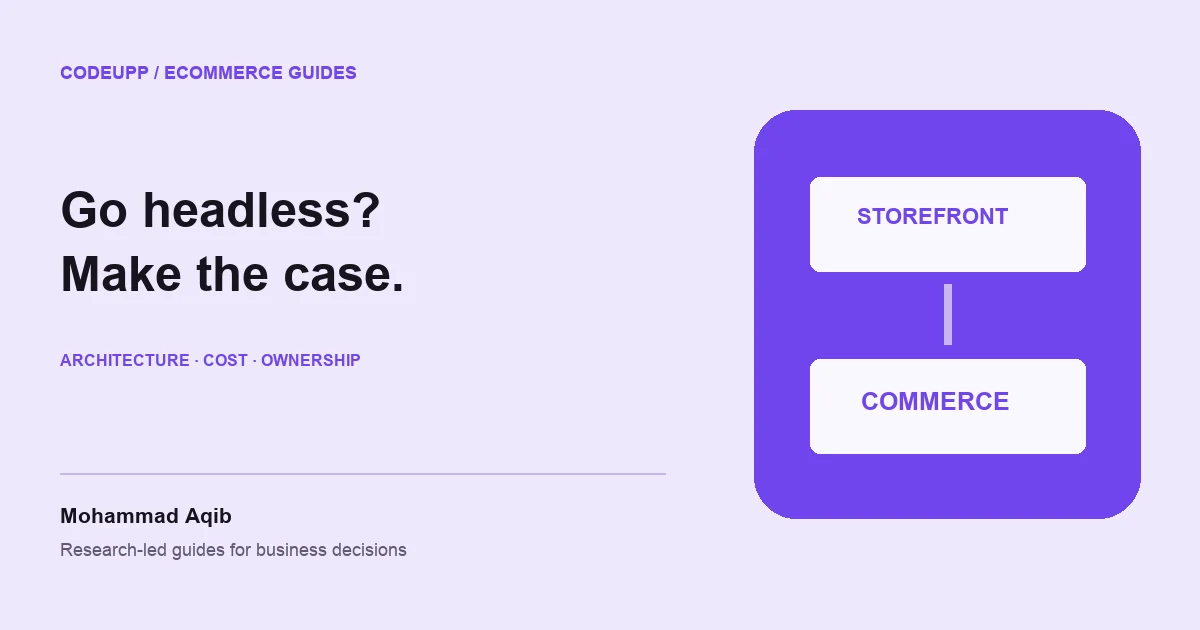
Headless commerce separates the customer-facing storefront from the system that manages commerce functions such as products, carts and orders. The two communicate through APIs. For a small or mid-size store, this can be worthwhile when a distinctive buying journey, several customer interfaces or difficult content requirements cannot be handled sensibly within the current platform. It is rarely a sound purchase merely because a developer prefers a modern framework or a competitor has adopted the label.
The decision is about control and responsibility. A conventional platform theme gives you a coordinated set of capabilities. A headless storefront gives the team more control over presentation, while making it responsible for connecting and maintaining parts that previously worked together. That can be a good trade when the additional freedom produces measurable value. It can also turn ordinary merchandising into development work if the editor, previews and app integrations are not designed properly.
Before requesting a quote, identify the specific constraint. Perhaps a product configurator cannot express your buying process, an editorial experience must combine several systems, or the same commerce engine needs to serve different interfaces. Write down what customers or staff cannot do today and the cost of that limitation. If the problem is oversized images, confusing delivery information or unnecessary scripts, a focused improvement to the existing storefront may solve it more economically than replacing the architecture.
What changes when the storefront is separated
A conventional store commonly combines templates, content, commerce functions and an administration environment. In a headless arrangement, the storefront requests information and initiates actions through defined interfaces. The commerce backend may still manage inventory and checkout, while another service handles editorial content or search. This is an architectural arrangement, not a guarantee of a particular programming language, hosting provider or customer experience. The exact boundaries should be drawn before costs are estimated.
Shopify's headless commerce documentation, checked on 16 October 2026, describes building custom storefronts using its commerce capabilities. Its official storefront information identifies Hydrogen tooling and Oxygen hosting as options, with Oxygen available on plans other than Starter. See Shopify's storefront options for current eligibility. These facilities can reduce some setup work, but they do not price the custom product design, integrations, editorial workflow or continuing engineering your business requires.
WooCommerce also exposes a Store API for customer-facing commerce functionality. API availability makes alternative storefronts possible; it does not establish that every extension will work unchanged in that arrangement. The practical question is which capabilities your store needs and whether each has a supported integration route. Our Shopify, WooCommerce and Laravel comparison explains the broader ownership differences before headless is added to the decision.
Three situations where headless deserves investigation
A buying journey that genuinely differs from a standard catalogue
A store selling configurable equipment may need compatibility checks, dependent options and a quotation path rather than a simple product page. A business selling bundles may need customers to build a valid combination before adding it to the cart. Headless can provide freedom to design that journey. First confirm whether the requirement can be implemented with supported platform facilities, because a custom interface introduces work beyond the initial configurator, including error states, analytics and maintenance.
Several interfaces need the same commerce capabilities
A business may want a website, an in-store interface and a mobile application to use shared product and cart information. A well-defined API boundary can support that arrangement. It still needs decisions about authentication, stock, pricing and the continuity of a customer's basket. The website versus mobile app guide helps determine whether an additional interface is justified. Building several channels before one performs well can multiply cost without proving demand.
Editorial and merchandising requirements are unusually demanding
A brand with extensive product education may need content assembled from several sources, sophisticated previews or a distinct publishing process. A separate content system can help when the requirements are real and maintained by capable staff. It can also create a fragmented experience if editors must switch between systems for a routine campaign. Include the merchandising team in discovery and have them demonstrate ordinary tasks before approving an architecture chosen mainly for developer convenience.
Reasons that are too weak on their own
Headless does not automatically make a store faster. The resulting performance depends on rendering, data requests, caching, images, scripts and infrastructure. A custom storefront can be fast, but it can also make too many requests or send unnecessary code to the browser. Establish a measured baseline and test a representative prototype. The Core Web Vitals guide explains how to define a performance problem before choosing an expensive remedy.
Nor does headless automatically improve search visibility. The team must preserve crawlable content, links, metadata and URL behaviour. Google's JavaScript SEO guidance explains the rendering considerations for JavaScript sites. That documentation supports careful implementation, not a promise that a framework improves rankings. A migration that changes URLs or loses useful content can introduce search problems even when the new interface looks better and loads quickly in a demonstration.
Headless also does not remove platform constraints from every part of the purchase journey. Checkout, payment methods, account features and commercial terms may still depend on the backend platform and plan. Ask exactly which screens are custom and which remain hosted elsewhere. For Gulf stores, verify the actual payment route using the gateway selection guide. A custom product page cannot enable a payment method for which the merchant has not been approved.
A cost model with explicit assumptions
The following models are illustrative labour calculations in US dollars, excluding taxes, platform subscriptions, paid services and internal staff time. Assumed hours include discovery, design, engineering, testing and delivery coordination. They are not market averages or supplier quotations. Their purpose is to show the difference between a bounded improvement, a focused headless build and a broader integration programme. Replace every assumption with the scope and rate of the team being considered.
| Approach | Assumed hours | Assumed hourly rate | Calculated labour |
|---|---|---|---|
| Improve an existing storefront | 120 | USD 60 | USD 7,200 |
| Build a focused headless storefront | 600 | USD 75 | USD 45,000 |
| Build a broader connected commerce experience | 1,200 | USD 100 | USD 120,000 |
The existing-store improvement might target performance, navigation and a difficult product flow. The focused headless scenario assumes a defined catalogue, a small integration set and an established commerce backend. The broader scenario may involve multiple content sources and more complex account or merchandising behaviour. None is an upper limit. A supplier should identify what it reuses, what it builds and what it excludes, rather than treating the word headless as a complete specification.
A credible quote separates storefront work from the supporting capabilities. Price search, content previews, localisation, analytics, customer accounts, cart behaviour, redirects and deployment. Include an inventory of existing apps and how each will work afterward. An app that inserts a widget into a platform theme may require a separate API or custom replacement. Discovering that after the build begins can erase an apparent budget advantage. The custom eCommerce budget guide provides a fuller procurement framework.
The operating cost is the more important comparison
Consider a fictional decision between a USD 7,200 improvement and a USD 45,000 headless build. The incremental implementation cost is USD 37,800. Suppose the headless arrangement also adds an assumed USD 600 monthly in combined engineering and services compared with the alternative. Across three years, that adds USD 21,600, bringing the incremental model to USD 59,400 before taxes and any major changes. These are constructed assumptions, not expected results for a particular merchant.
The business should explain how the additional investment could create value. If the expected benefit is higher sales, estimate contribution after product, payment and fulfilment costs rather than using gross revenue. If the benefit is faster publishing, identify the staff time or commercial delay it removes. Do not assume a conversion uplift simply because the architecture changes. The conversion benchmark guide explains why measurement and comparison need matching definitions and relevant segments.
A smaller business should pay particular attention to minimum continuing capacity. Even a quiet month may require dependency updates, provider changes or incident investigation. The maintenance cost guide distinguishes routine care, recovery and new features. A headless storefront can be reasonable when that ownership already exists. It is less attractive when every minor change requires finding a new specialist and reconstructing undocumented decisions left by the original project team.
The integration inventory reveals the real project
Catalogue, price and availability
Identify the system that owns each product fact and how changes reach the storefront. Cached information can improve responsiveness, but the business must decide how long a price or stock value may remain stale. Checkout should validate consequential information through the appropriate authoritative system. A page that promises an available item while the cart rejects it creates frustration. Test updates, out-of-stock states and product removal rather than only a static catalogue demonstration.
Search, reviews and merchandising
Ask how search indexes update and how staff control ranking or promoted products. Determine whether reviews are embedded through supported interfaces and how moderation works. A new storefront should not quietly lose useful merchandising capabilities because they were supplied by the old theme. Record the replacement or deliberate removal of each feature. Some can be simplified; others may be essential to the business. The decision should be visible to the people who use them daily.
Accounts, carts and checkout
Test guest and signed-in journeys, expired sessions, cart persistence and the transition into checkout. A shopper should not lose selected options or see an unexplained currency change. Account access must be enforced by the application and backend, not inferred from a user interface state. Failed payments and abandoned checkouts need sensible recovery. These are ordinary commerce requirements, but the separation of systems can create additional places where information becomes inconsistent or an error is difficult to trace.
Analytics and consent
Agree the event model before launch. Product views, cart additions and purchases should have consistent identifiers and deduplication. A purchase notification should not be counted twice because both a custom storefront and a backend integration send it. Consent and privacy controls must match the actual data flows, including third-party services. The data-protection comparison helps frame questions for the relevant review; architecture alone does not establish compliance.
Preserve the editor's ability to run the store
Ask an editor to create a landing page, schedule a promotion, correct a product description and preview a change before publication. Observe how many systems and technical interventions are required. The resulting workflow should be included in acceptance, because a storefront that developers admire but merchandisers cannot operate is not a successful business product. Define which layout choices editors control and which remain fixed to protect consistency and performance.
Preview environments need realistic data without unnecessarily exposing customer information. A draft campaign should show how it interacts with current products and navigation. Publishing should have an understandable status and recovery route. If content changes require a build, explain expected timing and failure handling. Editors should know whether a change is live, queued or failed. A vague instruction to ask the developer after every update transfers operating cost back to the business.
Localisation and international deployment require explicit testing
For stores serving the UAE, Saudi Arabia, Kuwait, Bahrain, Qatar and Oman, test Arabic-English navigation, product information, currency presentation and checkout continuity. Our Arabic website guide explains why a translated interface is not the whole customer journey. Verify that the headless design supports the exact payment integrations and merchant arrangement. Do not assume the flexibility of a custom front end removes account-level or country-specific restrictions imposed by providers.
For the United States, United Kingdom, Canada and Australia, and European markets such as Germany, France, the Netherlands and Ireland, define the genuine differences in content, shipping and support. The same discipline applies to India, Pakistan, Bangladesh, Singapore and other expansion markets. Build only the regional variants the business can maintain. Hosting and data flows should follow reviewed requirements, as discussed in the hosting-location guide, rather than being chosen solely because an edge-network map looks extensive.
Migrate in a way that preserves evidence
Inventory current URLs, important landing pages, product identifiers and analytics behaviour before building. Keep a record of which elements will remain and which will change. If URLs change, create and verify appropriate redirects. Test canonical metadata, internal links and product availability on representative pages. The redesign and SEO guide covers the wider migration process. Treat search continuity as a workstream with acceptance evidence, not a final checkbox after the new site is launched.
Keep the commercial backend stable where practical while evaluating the new storefront. A prototype can prove a difficult journey without replacing the entire store at once. Use realistic content and integration behaviour, and compare against the existing experience. Decide in advance what evidence would justify proceeding and what would lead to stopping. A technically successful prototype can still show that the benefit does not justify the ongoing cost, which is a valuable result from discovery.
A launch plan that includes failure
Define rollback before routing customers to the new storefront. Keep the old experience available where feasible and document the conditions that would trigger a reversal. Ensure orders remain traceable if a deployment occurs during an active shopping session. Monitor product access, carts, checkout transitions and order records after launch. A homepage availability check is insufficient when the business depends on several connected services. Assign an incident owner who can coordinate across storefront and backend suppliers.
Run a rehearsal that includes an unavailable API, a delayed content update, a failed search request and an expired customer session. The interface should remain understandable and avoid promising success when an operation is unconfirmed. Record diagnostic information that helps staff investigate without exposing unnecessary personal data. These operational requirements should appear in the budget. Otherwise, the apparent savings of assembling separate services may be offset by the effort of finding which service failed during a busy trading period.
A decision test for small and mid-size merchants
Write a short business case with the current constraint, the alternatives considered, implementation cost, recurring ownership and the evidence needed to demonstrate benefit. Give a conventional storefront improvement a fair comparison. Ask the proposed team to show the hardest journey, the editor workflow and the recovery process. The development-company selection guide helps evaluate whether the supplier can explain these trade-offs rather than merely promote a preferred stack.
Choose headless when the separation provides a specific advantage worth maintaining. Keep the current architecture when it can solve the problem more simply. Neither decision is permanent, and neither says anything about the ambition of the business. A well-run conventional store can be commercially sophisticated; a custom storefront can be justified at modest scale when the requirement is distinctive. The important evidence is the fit between the architecture, the people operating it and the value customers receive.
Frequently asked questions
Is headless commerce worth it for a small store?
Sometimes, but a standard storefront should be the benchmark. Headless is more credible when a valuable buying or publishing requirement cannot be handled sensibly within the existing platform. Compare implementation and continuing ownership costs with a simpler improvement before commissioning a separate storefront.
Does headless automatically improve speed or SEO?
No. Performance depends on the actual implementation, and search visibility depends on accessible content, links, metadata and migration quality among other factors. Measure the current problem and test a representative prototype. A framework choice is not evidence of a conversion or ranking improvement.
Does a headless store replace the commerce platform?
Not necessarily. The backend may continue to manage products, carts, orders and checkout while a custom storefront communicates through APIs. Identify the exact boundaries, because platform plans, payment eligibility and supported capabilities can still constrain parts of the customer journey.
What should a headless quotation include?
It should identify storefront scope, app replacements, content editing, search, accounts, cart behaviour, analytics, localisation, testing, deployment and ongoing care. Require explicit assumptions and exclusions. The labour examples in this article are planning models, not quotations or measured market averages.
Official sources and further checks
Related CodeUpp guides
Continue with a guide that matches your next step:
Web Development
- Website Speed and Core Web Vitals for Online Stores: Benchmarks, Fixes and Costs (2026 Guide)
- European Accessibility Act, ADA and WCAG 2.2: Is Your Website Legally Compliant? (EU, UK, USA, Canada)
- Website vs Mobile App for Your Business in 2026: Cost, Reach and Which to Build First
- Website Redesign Cost in 2026: When to Redesign, When to Rebuild and What It Does to Your SEO Rankings
- How to Choose a Web Development Company in 2026: 12 Questions to Ask Before You Sign (UAE, KSA, UK, USA)
- Website Development Cost in Saudi Arabia, Bahrain, Kuwait, Qatar and Oman: 2026 Guide
- How to Build a Website for the Arabic Market: RTL Design, Content and SEO Mistakes to Avoid
- Custom Laravel Development Cost in 2026: Pricing by Country and Project Type
- Freelancer vs Agency vs In-House Team: Who Should Build Your Website in 2026?
- Website Maintenance Cost in 2026: What Businesses in the UK, USA, Canada and the UAE Pay
- Web Development Trends in 2026: What Your Business Should Prioritize
Business Software
- UAE PDPL vs Saudi PDPL vs GDPR vs CCPA: Data Protection Rules Every Website Owner Must Know
- How Much Does Custom ERP Software Cost in 2026? UAE, Saudi Arabia, India, UK and USA Compared
- CRM Development Cost in 2026: Custom vs Off-the-Shelf for Growing Businesses
- How to Start an Online Business in Dubai in 2026: Licence, Website, Payments and Launch Checklist
eCommerce
- Cash on Delivery in Ecommerce: How It Works, Return Rates and How to Reduce Losses
- Ecommerce Conversion Rate Benchmarks by Country: What Is a Good Rate in the UAE, Saudi Arabia, USA, UK and India?
- Shopify vs WooCommerce vs Laravel: Which Is Best for Your Online Store in the Middle East?
- How to Build a Multi-Vendor Marketplace Like Amazon or Noon: Features, Cost and Timeline
- Best Payment Gateways for Online Stores in the UAE, Saudi Arabia, Kuwait and Bahrain: 2026
- eCommerce Website Cost in Bangladesh, Pakistan and India: What Local Stores Pay in 2026
- GDPR and Cookie Consent for Online Stores: A Practical Checklist for Denmark, Germany, France and the UK
- Botble CMS vs Shopify in 2026: Which Fits Your Online Store?
- How Much Does a Custom eCommerce Website Cost in 2026? A Global Budget Guide
- How to Create an Affordable eCommerce Website in 2026
- How to Create an eCommerce Store: From First Product to Global Launch
AI & eCommerce
Hosting
Blockchain
- How Much Does It Cost to Build a Crypto Exchange Like Binance in 2026?
- How Much Does a Smart Contract Audit and Development Cost in 2026?
- Web3 and DApp Development Cost in 2026: What Startups in the UAE, USA and Europe Should Budget
- How to Create a Crypto Token, Explorer and DApp: A Practical Guide
- EVM Blockchain Development: Architecture, Costs and Launch Planning
Have a project in mind? Let’s talk about it.