eCommerce
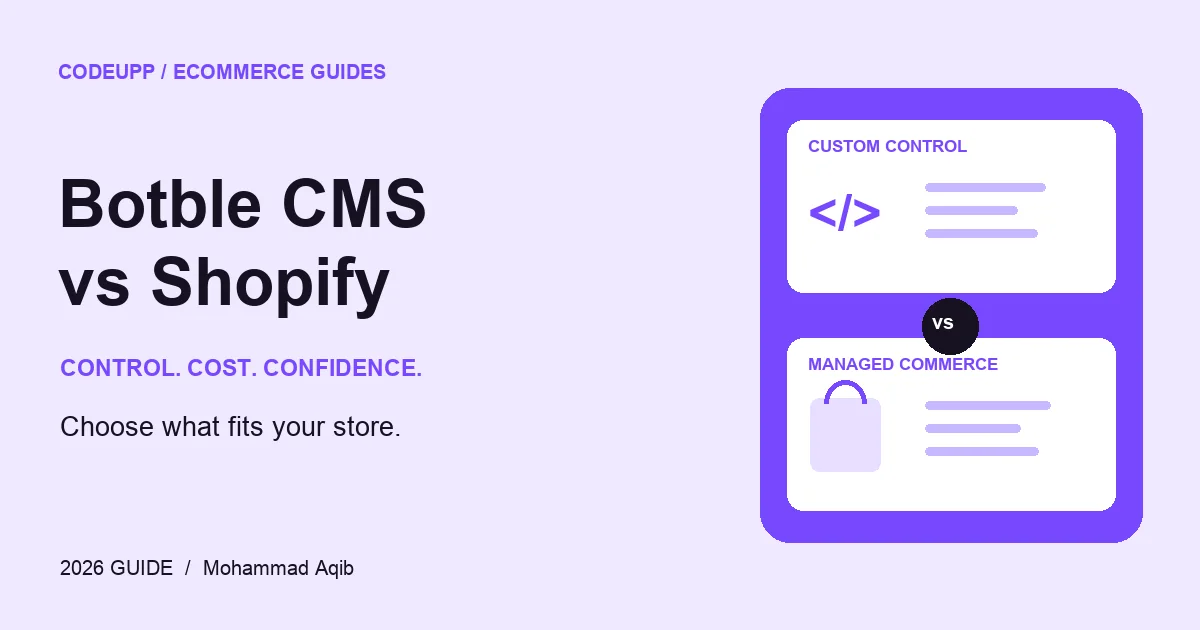
Botble CMS vs Shopify in 2026: Which Fits Your Online Store?
Rewritten 16 October 2026. Based on official product, pricing and licensing sources checked on this date. This is a decision guide, not a hands-on benchmark. Prices, plans, licenses and regional availability can change. Topic selection is based on reader intent; no keyword search-volume or competition data was available.
Quick answer: Botble CMS is a Shopify alternative worth considering when your store needs custom Laravel development and you have a team to maintain it. Shopify is often the more practical starting point when managed infrastructure and a straightforward launch matter most. Choose between them by testing your actual selling workflow, estimating the full operating cost, and deciding who will own technical maintenance. Neither platform is the best choice for every business.
The interesting question is not whether you can build an attractive storefront with either option. It is what happens after the first order: a customer changes an address, a supplier sends incorrect stock, a payment callback arrives twice, or an update conflicts with a customization. Your platform choice should make those ordinary situations manageable for the people running the business.
This guide compares a self-hosted Botble-based eCommerce implementation with a Shopify store. It focuses on practical buying and delivery decisions for founders, store managers, and development teams. It is researched guidance, not a claim that CodeUpp has run a controlled performance test between the two products.
What Botble CMS is, and what you should actually evaluate
Botble provides a Laravel-based CMS ecosystem with eCommerce products and themes. The product you select matters: a CMS foundation, a particular eCommerce theme, and a multi-tenant store-hosting product are not interchangeable purchases. Start with the documentation for the exact item you intend to install, then confirm the included commerce features, requirements, and license.
A useful evaluation begins with your catalog rather than the demo homepage. Bring representative products, variant combinations, shipping destinations, and refund scenarios. Ask the implementation team to show how those cases work in the proposed version. If a feature needs an extension or custom code, record that dependency before agreeing on a price.
Source access and software ownership are different
Botble's published terms allow source modifications within the purchased license, but the purchase does not transfer the vendor's intellectual property. Redistribution and additional deployments are subject to restrictions. Read the current terms for your specific purchase and obtain written clarification for unusual licensing arrangements. Access to application code should never be described as permission to resell the underlying product without limits.
Your development agreement should separately identify ownership and handover of your original content, branding, custom integrations, and project-specific work. Keep purchase records and administrative access under business control. This makes it easier to change development partners without confusing your own assets with third-party licensed components.
Botble versus Shopify at a glance
Use the comparison below to identify where a proof of concept is needed. It is a decision framework, not a feature inventory for every version, subscription tier, or extension. An item marked for validation should become a question in your brief rather than an assumption in your budget.
| Decision | Botble-based store | Shopify store |
|---|---|---|
| Infrastructure | Select and maintain a suitable hosting setup | Hosted platform infrastructure is included |
| Customization | Work within the codebase and purchased license | Use supported themes, apps, APIs and plan-dependent capabilities |
| Cost structure | License, delivery, hosting and ongoing maintenance | Subscription, delivery, optional apps and applicable payment fees |
| Operational owner | Your team or contracted hosting and development providers | Shopify handles the platform; your team manages store configuration and integrations |
| Integration assessment | Confirm the selected product and build missing connections | Confirm app or API coverage and relevant plan limits |
| Best starting question | Can we support the custom workflow over time? | Can the workflow fit the supported platform capabilities? |
A small company can make either model work. The difference is where responsibility sits and how the team handles exceptions. A self-hosted store with a dependable maintenance agreement can be easier to operate than a poorly configured hosted store. Equally, a hosted store can save a small team from spending its limited attention on infrastructure.
When Botble can be a good Shopify alternative
Your commercial workflow needs custom application logic
Consider a wholesaler whose buyers must receive account approval before ordering, whose prices come from an external system, and whose warehouse releases orders in batches. The important requirement is the complete approval-to-dispatch process. A development team should prototype that process, including rejection, partial fulfillment, and cancellation, before recommending a platform.
Botble may be a useful foundation when the required changes belong in application logic and the team already has relevant Laravel experience. That is a reason to evaluate it, not proof that every requested feature already exists. Ask what will be configured, what will be bought separately, and what will be developed specifically for your store.
You want more direct control over deployment
A self-hosted project lets you choose an appropriate hosting arrangement and organize your own deployment process. That control is useful when an existing technical team already manages related systems. It also creates work: someone needs to monitor the service, review upgrades, manage credentials, and restore the site when something goes wrong.
You have a sustainable development relationship
The strongest case for customization includes a maintenance plan from the beginning. Identify the people who can diagnose a failed order synchronization or safely change a shipping rule six months after launch. If the answer is one unavailable freelancer with undocumented code, the apparent flexibility can become a business dependency.
When Shopify is likely to be the more practical choice
Shopify is worth prioritizing when the business needs to start selling through a relatively conventional catalog and has little appetite for maintaining hosting infrastructure. Its published pricing includes hosting, while its app and developer ecosystem provides ways to extend a store. Specific capabilities vary by plan and integration, so validate your requirements against current documentation.
For a founder testing demand, the biggest early risk may be buying inventory that does not sell. Spending heavily on bespoke software before validating the offer can make that risk worse. A simpler store can help the team learn which products, delivery promises, and customer questions actually matter before funding additional engineering.
Shopify also deserves a fair evaluation when your preferred fulfillment or marketing tools already have well-supported integrations. Ask who maintains each connection, what it costs, and how failures are reported. An existing connector can reduce implementation work, but its presence in a marketplace does not establish that it supports every field or workflow you need.
Avoid assuming that a hosted platform means no development work. Theme changes, data preparation, integrations, analytics, and staff training can still require specialist help. The advantage is a different division of responsibilities, not the disappearance of all technical decisions.
Compare the full cost, not the first invoice
A license price and a monthly subscription are different units. Comparing them directly leaves out most of the work required to launch and operate a useful store. Build a first-year budget, then a recurring annual budget using the same catalog, integrations, service expectations, and order assumptions for both options.
Shopify subscription pricing in context
The Shopify pricing page checked on 16 October 2026 displayed US-dollar Basic pricing of $39 per month on monthly billing or $29 per month with yearly billing. These are reference figures for that displayed pricing context, not a worldwide quote. Check your local checkout, billing commitment, taxes, and selected plan before purchasing. Optional apps, themes, and implementation services can add to the subscription.
Botble implementation and ongoing costs
For Botble, obtain the current price for the precise licensed product and any required add-ons. Then separately price setup, design adjustments, data migration, payment integration, hosting, monitoring, backups, and maintenance. A low initial software price cannot tell you whether the finished store will cost less over its operating life.
| Budget item | What to include | Evidence to request |
|---|---|---|
| Initial setup | Configuration, catalog preparation and delivery | Written scope and acceptance checklist |
| Design work | Templates, accessibility and responsive adjustments | Approved page list and revision allowance |
| Integrations | Payment, shipping, stock and other business systems | Tested workflows and dependency list |
| Recurring services | Hosting or subscription, email and paid extensions | Renewal prices and billing owner |
| Maintenance | Updates, incident handling and regression checks | Named owner and service agreement |
| Migration or exit | Data exports, redirects and transition support | Export sample and handover plan |
A useful break-even calculation
Suppose, purely as an illustration, one option needs $3,000 more implementation work but appears to save $100 each month in comparable recurring costs. Dividing the extra implementation cost by the monthly saving gives a 30-month break-even period. This is arithmetic, not a quote or a prediction of what either platform will cost your business.
Now include the value of maintenance time, support, and expected replacement work. If those items consume the monthly saving, the original comparison no longer holds. Use conservative assumptions and write them down so a change in sales volume or integration requirements does not quietly invalidate the decision. Our eCommerce cost guide explains how to build a broader project budget.
Payment fees: separate the different charges
A platform charge, a payment processor fee, and a currency conversion charge are different expenses. Shopify documents third-party transaction fees that depend on the plan and payment setup, along with exceptions. Its help guidance explains that eligible orders processed through Shopify Payments do not incur those third-party transaction fees; processing charges can still apply. Confirm the rules relevant to your store rather than assuming every order has the same fee structure.
Self-hosting does not make payment processing free. With a Botble-based store, review the gateway contract, currency conversion, refunds, chargebacks, and any connector-related costs. Also verify that the selected gateway can onboard your business and settle funds to your account. A plugin appearing in a demo is not evidence of merchant eligibility.
For comparison, use the same expected order count and average basket value on both sides. Include cross-border sales if they are part of your plan. Test a successful payment, a failed payment, a cancelled attempt, a duplicate notification, and a refund. The financial outcome and order status should remain understandable to the store manager in each case.
Customization without creating an expensive maintenance problem
Customization is useful when it removes friction from a valuable business process. It is much less useful when it duplicates a standard feature simply because someone prefers a different implementation. Separate essential launch requirements from experiments that can wait until you have evidence from real customers.
Describe the result before selecting an extension
Instead of requesting a generic inventory integration, specify which system owns stock, how quickly changes must appear, and what should happen if synchronization stops. Define whether a backorder is allowed, how reserved stock is represented, and who receives an alert when two systems disagree. Those decisions affect the design more than the integration's label.
Keep a record of custom changes
Ask for version control, deployment instructions, and a list of modifications that need attention during vendor updates. Request a staging environment where your team can review changes before customers see them. The exact method can vary, but a safe process should make it possible to identify what changed and recover from a problematic release.
Write an acceptance example for each critical rule
For a custom delivery surcharge, an acceptance example could state: a qualifying postcode adds the agreed charge, a non-qualifying postcode does not, and the final amount is visible before payment. Include boundary cases such as an empty postcode or an unsupported destination. This is more useful than approving a feature called advanced shipping without defining its behavior.
Performance and SEO depend on the finished implementation
Neither Botble nor Shopify wins a performance comparison merely because of its architecture. Product media, third-party scripts, template choices, caching, hosting conditions, and the way integrations run can affect the customer experience. This guide does not report controlled benchmark results, so it does not claim one platform is universally faster.
Build an evaluation around representative pages: a category with filters, a detailed product, the cart, and the checkout path. Review mobile layouts with realistic product images and content. Record your testing conditions and repeat the checks after adding the tools that will actually ship. An empty demo is not a reliable substitute for your final storefront.
Keep search requirements in the delivery checklist
Specify readable titles, useful descriptions, crawlable navigation, canonical URLs, and a sitemap that includes the pages you intend to expose. Decide how filtered categories, variant URLs, and discontinued products should behave. Check that structured data describes visible information rather than promising ratings or availability that the page does not show.
For answer engines and AI-assisted discovery, write clear explanations of product suitability, specifications, delivery, and returns. Use consistent names and show the evidence behind factual claims. These steps help readers and machines understand your content; they do not guarantee rankings or citations. Adding repeated country keywords cannot replace a helpful product page or a reliable checkout.
Security, backups, and support need named owners
Before launch, make a small responsibility table covering the application, hosting, domain, email delivery, payment setup, and customer support. Write down who receives alerts and who can approve urgent changes. A shared assumption that somebody else handles security is a weak operating plan on any platform.
For a self-hosted project, agree how updates are reviewed, how access is granted, and how credentials are removed when a contractor leaves. Backups should be recoverable, not merely reported as successful. Schedule a restoration exercise in an isolated environment and confirm which data would be lost if the latest recovery point had to be used.
Support also has several layers. Vendor support may help with the purchased product, while your developer handles custom code and a hosting provider handles infrastructure. Ask which issues fall outside each agreement. A promise of ongoing support is only useful when you know the contact route, coverage, response expectations, and cost of additional work.
International stores: validate the market, not just the currency switcher
A globally accessible website is not automatically ready to sell everywhere. Choose the markets you will actually serve at launch, then verify merchant payment eligibility, settlement currency, shipping coverage, returns handling, and the language customers need. Do not select a platform because it displays a long list of flags in a demo.
For example, a UAE business planning Arabic and English content should review right-to-left layouts with real product names, address fields, and checkout messages. A UK or Canadian merchant expanding abroad should test destination-specific shipping and pricing communication. These are practical evaluation scenarios, not claims that a particular feature or payment method is included for every country.
Document which specialist will validate applicable tax, privacy, and consumer requirements. The implementation team can configure the agreed behavior, but a generic platform comparison cannot establish every business's legal obligations. Start with a manageable market scope and add countries only when the operating process is ready to support them.
Moving from Shopify to Botble: a controlled migration plan
A migration should solve a defined problem. Write down what the current store cannot do economically or reliably, then prove that the proposed replacement addresses it. Changing platforms because another tool looks cheaper can introduce data, search, and customer-service problems that outweigh the apparent saving.
Map the data and URLs first
Inventory products, variants, images, customers, orders, discounts, content, and integration dependencies. Decide what must be migrated, what can remain in a secure archive, and how staff will find historical records. Do not assume customer credentials, app-specific fields, or subscription relationships can be transferred unchanged. Confirm each item through an export and import trial.
Create an explicit old-to-new URL map. Preserve useful URLs where possible and use permanent redirects when they must change. Update internal links, canonical references, and sitemaps to point directly to the new destinations. Check important product and editorial links individually; a working homepage does not prove the rest of the migration is correct.
Rehearse the cutover before changing the live store
Import a representative sample into staging and reconcile totals and variant relationships. Run payment tests using the provider's supported test process, confirm notification behavior, and check fulfillment handoff. Agree on a brief change window, a method for reconciling orders created during transition, and a rollback decision point.
Keep the old environment or required exports available according to your retention and contractual needs. After launch, monitor missing pages, failed payments, stock discrepancies, and customer-service reports. Assign people to resolve these findings rather than treating the domain switch as the end of the project.
A practical first-week evaluation checklist
You do not need a polished full store to learn whether the platform fits. Use a short evaluation with the hardest ordinary cases in your business, then turn the results into a delivery brief. The purpose is to reduce uncertainty before committing to a larger implementation.
- Day one: list the essential customer and staff journeys, separate launch requirements from later ideas, and choose a representative product sample.
- Day two: test product editing, variants, images, category navigation, and search using that sample rather than placeholder demo content.
- Day three: validate payment eligibility, the order lifecycle, refunds, shipping rules, and the customer messages needed when something fails.
- Day four: review integration ownership, update procedures, backup recovery, credentials, and the handover documents your team will receive.
- Day five: compare written total-cost estimates, record unresolved dependencies, and decide whether a focused prototype is needed before approval.
Bring the people who will operate the store into the evaluation. A warehouse manager may notice an awkward packing workflow that a founder misses. A customer-service colleague may need order notes or a clear refund history. Their feedback can prevent expensive changes after the design has already been approved.
Frequently asked questions
Is Botble CMS better than Shopify?
Botble can suit a business that needs custom application behavior and has a capable maintenance team. Shopify can suit a business that values managed infrastructure and a supported standard selling workflow. The better choice depends on the specific product, integrations, budget, and people responsible for operating the store.
Is Botble CMS free or open source?
Do not assume that Laravel-based software is free or unrestricted. Botble products are distributed under their applicable purchase licenses. Check the exact product terms for permitted modifications, domains, and use cases. Source access does not transfer ownership of Botble's intellectual property or grant unrestricted redistribution rights.
Does a Botble store have no recurring costs?
No. Hosting, domains, maintenance, backups, email services, and third-party integrations can create recurring costs. Payment processing can also carry charges. Ask for an operating budget alongside the implementation quote, including who maintains custom work and how renewals are handled.
Can Shopify be customized?
Yes. Shopify supports customization through themes, apps, APIs, and other documented extension mechanisms. Some capabilities depend on the plan and supported interfaces. Identify the exact business requirement and validate the relevant approach before concluding that a custom implementation elsewhere is necessary.
Which platform is cheaper for a small store?
There is no universal answer. Compare the same scope over a defined period, including delivery, recurring services, payment costs, and maintenance time. A lower software purchase price may be offset by custom development, while unnecessary subscriptions can make a hosted store more expensive than expected.
Is Botble automatically faster or better for SEO?
No automatic advantage is established here. Evaluate the finished site with representative products, media, scripts, and traffic assumptions. Both performance and search visibility depend on implementation and content. Useful metadata, accessible navigation, and accurate structured data support understanding but do not guarantee rankings.
Can I migrate existing Shopify products and orders?
Treat migration as a mapping and validation project. Test available exports against the destination's import process and document which records or fields need transformation. Confirm order history, customer information, images, variants, and redirects separately. Do not promise complete migration before reviewing the actual data and dependencies.
Will my local payment gateway work?
Confirm both technical compatibility and merchant eligibility. The integration must support your required transaction and refund flows, while the provider must accept your business and settlement arrangement. Test the proposed setup before launch; a gateway logo or available plugin does not establish either requirement by itself.
Do I need a developer to run Botble?
Routine content and order tasks may be manageable after training, but deployment, customization, upgrades, and incident handling need appropriate technical support. Agree on those responsibilities before purchasing an implementation. A clear maintenance arrangement is especially important when custom integrations are business critical.
Should I rebuild a Shopify store that already works?
Only consider rebuilding when a documented constraint justifies the cost and disruption. Compare improving the existing implementation with migrating. Include data validation, redirects, staff training, parallel operating costs, and the risk of interruption in the decision rather than comparing software fees alone.
The verdict: choose the workflow you can sustain
Botble is a credible option to evaluate for a custom Laravel-based store, especially when a defined workflow needs development and the business can maintain it responsibly. Shopify remains a strong option to evaluate when a supported hosted setup fits the selling process and reduces operational work. A useful recommendation explains that fit instead of declaring a universal winner.
Start with a brief containing your catalog, markets, payments, shipping rules, integrations, and operating responsibilities. Ask each proposed implementation team to demonstrate the difficult cases and price the same scope. Then choose the plan your business can understand, afford, and support after launch. For help assessing that scope, explore our Botble development services or contact the CodeUpp team.
Official sources and further checks
- Botble documentation — product-specific implementation guides (checked 16 October 2026)
- Botble terms — licensing, modification and support (checked 16 October 2026)
- Shopify pricing — plans, billing and included hosting (checked 16 October 2026)
- Shopify help — third-party transaction fees and exceptions (checked 16 October 2026)
Related CodeUpp guides
Continue with a guide that matches your next step:
Web Development
- Website Speed and Core Web Vitals for Online Stores: Benchmarks, Fixes and Costs (2026 Guide)
- European Accessibility Act, ADA and WCAG 2.2: Is Your Website Legally Compliant? (EU, UK, USA, Canada)
- Website vs Mobile App for Your Business in 2026: Cost, Reach and Which to Build First
- Website Redesign Cost in 2026: When to Redesign, When to Rebuild and What It Does to Your SEO Rankings
- How to Choose a Web Development Company in 2026: 12 Questions to Ask Before You Sign (UAE, KSA, UK, USA)
- Website Development Cost in Saudi Arabia, Bahrain, Kuwait, Qatar and Oman: 2026 Guide
- How to Build a Website for the Arabic Market: RTL Design, Content and SEO Mistakes to Avoid
- Custom Laravel Development Cost in 2026: Pricing by Country and Project Type
- Freelancer vs Agency vs In-House Team: Who Should Build Your Website in 2026?
- Website Maintenance Cost in 2026: What Businesses in the UK, USA, Canada and the UAE Pay
- Web Development Trends in 2026: What Your Business Should Prioritize
Business Software
- UAE PDPL vs Saudi PDPL vs GDPR vs CCPA: Data Protection Rules Every Website Owner Must Know
- How Much Does Custom ERP Software Cost in 2026? UAE, Saudi Arabia, India, UK and USA Compared
- CRM Development Cost in 2026: Custom vs Off-the-Shelf for Growing Businesses
- How to Start an Online Business in Dubai in 2026: Licence, Website, Payments and Launch Checklist
eCommerce
- Headless Commerce Explained: Is It Worth the Cost for Small and Mid-Size Stores?
- Cash on Delivery in Ecommerce: How It Works, Return Rates and How to Reduce Losses
- Ecommerce Conversion Rate Benchmarks by Country: What Is a Good Rate in the UAE, Saudi Arabia, USA, UK and India?
- Shopify vs WooCommerce vs Laravel: Which Is Best for Your Online Store in the Middle East?
- How to Build a Multi-Vendor Marketplace Like Amazon or Noon: Features, Cost and Timeline
- Best Payment Gateways for Online Stores in the UAE, Saudi Arabia, Kuwait and Bahrain: 2026
- eCommerce Website Cost in Bangladesh, Pakistan and India: What Local Stores Pay in 2026
- GDPR and Cookie Consent for Online Stores: A Practical Checklist for Denmark, Germany, France and the UK
- How Much Does a Custom eCommerce Website Cost in 2026? A Global Budget Guide
- How to Create an Affordable eCommerce Website in 2026
- How to Create an eCommerce Store: From First Product to Global Launch
AI & eCommerce
Hosting
Blockchain
- How Much Does It Cost to Build a Crypto Exchange Like Binance in 2026?
- How Much Does a Smart Contract Audit and Development Cost in 2026?
- Web3 and DApp Development Cost in 2026: What Startups in the UAE, USA and Europe Should Budget
- How to Create a Crypto Token, Explorer and DApp: A Practical Guide
- EVM Blockchain Development: Architecture, Costs and Launch Planning
Have a project in mind? Let’s talk about it.